

Now more than ever, we’re aware of how important good mental health is to a healthy, thriving life — at all ages.
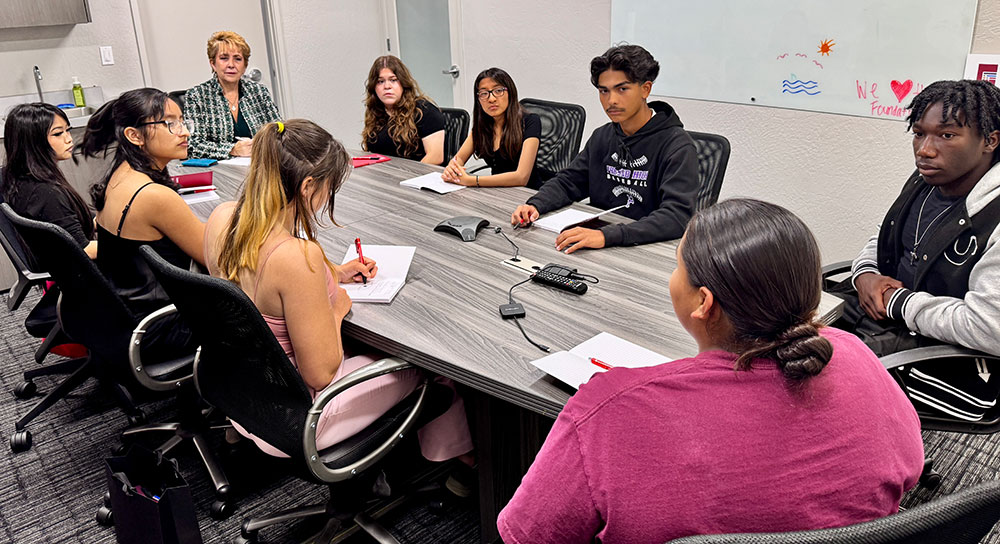
To support the well-being of local high school students, Community Health System invested in Fresno Unified School District’s student mental health council, where students give firsthand feedback on which resources are most effective in helping them manage their mental health.
Student voices are important in shaping their mental health needs
In talking with students, educator Linda Laettner and her colleagues saw a common concern: a growing need for accessible mental health resources. Despite availability, some students still weren’t asking for help.
Laettner serves as an executive officer for The Foundation for Fresno Unified Students, an organization focused on scholarships, programs and community partnerships that support student success.
“It really became evident our students weren’t getting what they needed in order to support positive mental health,” said Laettner. “Too often as adults we have a habit of saying we know what our students need, and we know how they need to get it — without talking to [them].”
The foundation partnered with research company DoSomething Strategic to do a “landscape analysis” — to find out what worked and what didn’t for students when it came to mental health resources.
That analysis involved the creation of a student mental health council. Initially, students on the council met with their peers to talk about the effectiveness of current mental health support. From there, the council moved to an “ideation” phase, where they brainstormed ideal ways to receive mental health support.
Setting a base for student success
Apollo Juarez is a graduating high school senior and council member, and a champion of effective mental health resources for people his age.
“The big goal of the council is to hear student voices and make sure students play a part in creating solutions for issues [we’re] experiencing,” he said.
Juarez knows that, while adults may have the best intentions, they may not know how to meet students where they are situated.
“Your intentions can be great, and you can intend to help, but if you aren’t listening to younger people, then you don’t know how to help them.”
Luz Rojas, fellow high school senior and council member, agrees on the importance of having students participate in these types of discussions.
"If students don’t have really good mental health, that affects their academics, their home life, their interactions with other students, with teachers...,” she said. “It really sets a base for success.”
Mental health a top health need of the Central Valley
The 2025-2028 Community Health Needs Assessment (CHNA) identifies mental health as one of our region’s top health needs. The CHNA is a data collection and analysis tool used to provide a deeper understanding of the health status, needs, disparities and desires of the communities the hospital system serves. CHNA findings help guide us in our mission to identify, develop and implement actionable strategies to improve the health and well-being of the Central Valley.
In the most recent CHNA, Fresno, Kings, Madera and Tulare counties all reported a higher percentage of poor mental health days compared to the national average.
Mental health still viewed as “taboo” despite widespread need
During their time on the council, Juarez and Rojas learned more about the resources available on campus and were able to direct their classmates to them.
Juarez acknowledges that, though conversations about mental health have become more common, it remains a topic still viewed by some as “taboo.”
“There’s always going to be people who think that mental health is not widely experienced, that it’s a problem a very select few faces, which is just not true at all,” he said.
“Whether you’re in crisis or just experiencing stress, mental health struggles are a very normal thing.”